
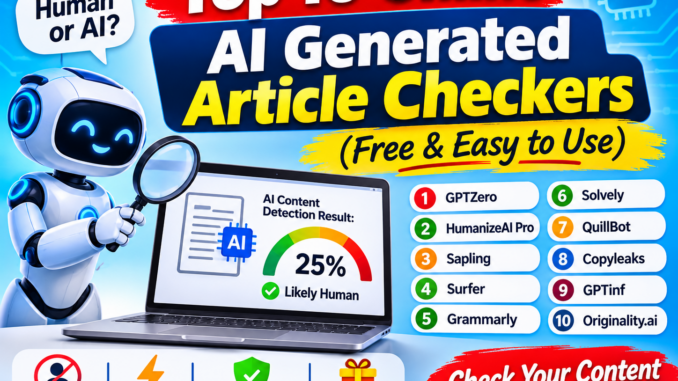
Discover the top 10 online AI generated article checkers. Compare free AI content detectors to check whether articles and text may be AI-written.
With the rapid growth of Artificial Intelligence, AI writing tools have become increasingly popular for creating blog posts, articles, essays, website content, and other written materials. However, it is not always easy to determine whether a piece of content was written by a human or generated using AI.
This is where AI-generated article checkers become useful. These online tools analyze writing patterns and estimate whether a text may have been generated by artificial intelligence tools such as ChatGPT and other AI writing assistants.
If you are a blogger, student, content writer, teacher, or website owner, an AI content detector can help you review your written content. In this article, we will explore the top 10 online AI-generated article checkers that you can use to analyze text and understand the likelihood of AI-generated content.
Top Features of Online AI Article Checkers
Most online AI content detection websites offer convenient features that make content analysis easier.
- No Login or Signup Required: Some AI detectors allow users to check text without creating an account.
- Easy Copy and Paste: Simply copy your article or written content and paste it into the detector.
- AI Content Detection: These tools analyze writing patterns to estimate whether content may be AI-generated.
- Free Checking Options: Many platforms provide free checks, although word limits and features may vary.
- Quick Results: Get an AI detection report within a short time, depending on the tool and text length.
- Simple Interface: Most tools are browser-based and do not require software installation.
Top 10 Online AI Generated Article Checkers
1. GPTZero
GPTZero is one of the popular online AI content detection platforms designed to identify text that may have been generated using artificial intelligence. It is useful for students, teachers, bloggers, and content creators who want to analyze written material.
Users can paste their articles or other text into the platform and receive an AI detection report. GPTZero analyzes writing patterns and provides an estimate of whether the submitted content may be AI-generated or human-written.
Best for: Students, educators, bloggers, and content reviewers.
2. HumanizeAI Pro Detector
HumanizeAI Pro provides an online AI content detector that users can explore to analyze written text. It is designed for people who want to check whether their articles, blog posts, or other content might be identified as AI-generated.
The tool offers a straightforward text-checking experience. Users can paste their content into the detector and review the available results to understand how the submitted writing is classified.
Best for: Bloggers, freelance writers, and website content creators.
3. Sapling AI Content Detector
Sapling AI Content Detector is an online tool that helps users estimate whether a piece of text may have been written using artificial intelligence. It can be useful when reviewing articles, paragraphs, emails, and other written materials.
Its simple interface makes it easy to submit text for analysis and view the detection results. Sapling is worth exploring for people who want an additional opinion when checking AI-generated content.
Best for: Professional writers, editors, and businesses.
4. Surfer AI Content Detector
Surfer offers an AI content detection tool for users who want to examine written material and estimate its likelihood of being AI-generated. It is particularly relevant to people working in blogging, SEO, and digital content publishing.
Users can explore the detector to analyze their written content and review the available results. It can be a useful addition to a content review process, especially for website owners and SEO professionals.
Best for: SEO professionals, digital marketers, and bloggers.
5. Grammarly AI Detector
Grammarly is widely recognized for its writing assistance and grammar-checking features. It also provides AI detection functionality that users can explore to estimate whether submitted text may have been generated by AI.
The platform is useful for people who regularly work with written content and want to review its quality. Its writing-focused ecosystem makes it a convenient option for students, professionals, and content editors.
Best for: Students, professionals, and content editors.
6. Solvely AI Detector
Solvely provides an online AI detection tool that users can explore when checking articles and other written content. It is designed to help users estimate whether text may have been created using artificial intelligence.
The browser-based approach makes it convenient to access without installing additional software. Users can submit their text and review the available detection results to get another perspective on their content.
Best for: Students, bloggers, and general content users.
7. QuillBot AI Detector
QuillBot is a popular online writing platform offering several writing-related tools. Its AI Detector helps users estimate whether text may have been generated by artificial intelligence.
Users can submit their written content and review the detection results. QuillBot is especially useful for people who want access to writing, paraphrasing, and content analysis tools within one platform.
Best for: Students, writers, and content creators.
8. Copyleaks AI Detector
Copyleaks offers an AI content detection solution designed to help identify text that may have been generated using artificial intelligence. It is suitable for educational institutions, businesses, publishers, and professional content reviewers.
The platform analyzes submitted text and provides detection results to help users evaluate the origin of written content. It is also worth considering for organizations that need content review tools as part of their workflow.
Best for: Educational institutions, businesses, and publishers.
9. GPTinf AI Detector
GPTinf provides an online AI detection tool that users can explore to check written content. It is another option for people who want to estimate whether an article, paragraph, or other text might have been generated by artificial intelligence.
The online interface offers a convenient way to submit text and review the available analysis. Users can include it in their content-checking process when comparing results from multiple AI detection platforms.
Best for: Freelance writers, bloggers, and content reviewers.
10. Originality.ai
Originality.ai is a content verification platform known for its AI detection and plagiarism-checking capabilities. It is designed for content publishers, SEO agencies, website owners, and professional writers who want to review content before publication.
The platform offers tools to analyze written material and assess the likelihood of AI-generated text. Its combination of content verification features makes it a useful option for people managing blogs, websites, and digital publishing projects.
Best for: Content agencies, publishers, SEO teams, and website owners.
Key Limitations of Online AI Content Detectors
Although AI content detectors can be useful, it is important to understand their limitations before relying on their results.
1. False Positives and False Negatives
AI detectors are not always accurate. Sometimes, human-written content may be incorrectly identified as AI-generated. Similarly, AI-generated content may not always be detected.
Formal writing, academic language, repetitive sentence structures, and non-native English writing can sometimes affect detection results.
2. AI Detection Is Different from Plagiarism Checking
AI detectors and plagiarism checkers perform different tasks. AI detectors analyze writing patterns to estimate whether text may have been generated using artificial intelligence.
Plagiarism checkers, on the other hand, compare submitted content against existing sources to identify potentially copied or matching text. If you want to check both, consider using separate tools.
3. Short Texts Can Produce Unreliable Results
Very short paragraphs or sentences may not provide enough information for an AI detector to make a meaningful assessment.
For better context, it is generally preferable to analyze a longer passage when the tool supports it. However, even longer content does not guarantee an accurate result.
4. Different Detectors May Give Different Scores
One AI detector may classify an article as mostly human-written, while another may identify some portions as AI-generated.
This happens because different platforms use different detection methods and models. Therefore, it is better to compare results from multiple tools instead of relying on a single score.
5. AI Detection Scores Are Not Proof
An AI detection percentage should not be treated as definitive evidence of who wrote an article. These tools provide estimates based on statistical patterns, not guaranteed proof of authorship.
Always consider the writing process, original drafts, references, and other relevant evidence before making important decisions.
How to Check an Article Using an Online AI Detector
Checking an article with an online AI content detector is generally simple. Follow these steps:
- Open any AI content detector from the list above.
- Copy the article or written content you want to analyze.
- Paste the text into the detector’s input box.
- Click the available check or analyze button.
- Wait for the tool to process the submitted content.
- Review the AI detection score or report.
- If necessary, compare the results with another AI detector.
Different platforms may have different word limits, account requirements, and checking options.
Conclusion
Online AI-generated article checkers are useful tools for bloggers, students, writers, educators, and website owners who want to analyze written content. They can provide helpful insights into whether an article may have been generated using artificial intelligence.
The 10 websites covered in this article include GPTZero, HumanizeAI Pro, Sapling, Surfer, Grammarly, Solvely, QuillBot, Copyleaks, GPTinf, and Originality.ai.
Each platform offers a different approach to AI content detection, so you can explore multiple tools and compare their results. However, remember that no AI detector is 100% accurate. Always treat detection scores as estimates rather than final proof of whether content was written by a human or AI.
Choose an AI detector based on your requirements, ease of use, available features, privacy practices, and pricing. Using these tools responsibly can help you make more informed decisions when reviewing online content.