
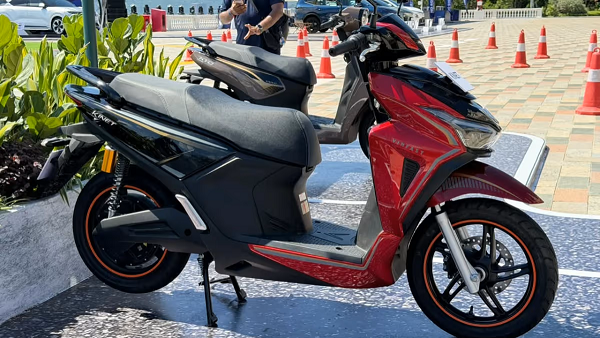
Vietnamese electric vehicle manufacturer VinFast is preparing to expand its presence in India’s two-wheeler market. After establishing its electric car business, the company is now working towards building a dedicated electric scooter dealership and service network in the country.
Several VinFast electric scooters could be considered for India, including the Evo, Kyo and Kinet. However, the company has not officially confirmed these three models as its Indian launch lineup. Its previously announced international electric scooter portfolio also includes the Evo, Feliz II and Viper.
The Vietnamese versions of these scooters provide an idea of the technology, performance and features that VinFast could bring to India. The final Indian models are likely to receive changes to their specifications, equipment and design to suit local requirements.
While an India launch timeline has not been officially announced, the company’s dealer-network expansion suggests that its electric two-wheeler plans are moving forward.
Here is what we know about the three scooters featured in its Vietnamese lineup and what Indian buyers can potentially expect.
VinFast Evo: An Affordable Electric Scooter for Daily Commuting
The VinFast Evo could be an interesting option for Indian buyers looking for a practical electric scooter for everyday use.
It follows a conventional scooter design, prioritising comfort, usability and straightforward styling rather than a sporty appearance. This approach could make it suitable for family buyers and urban commuters.
The Vietnamese-specification VinFast Evo uses a hub-mounted electric motor producing a peak output of 2.45kW. Its claimed top speed is 70kmph.
The scooter comes with a 1.5kWh LFP battery, with provision for an additional battery of the same capacity. With both batteries installed, VinFast claims a maximum range of approximately 165km under its test conditions.
The company also claims a 0-50kmph acceleration time of around 16 seconds with a 65kg rider. This suggests that the Evo is designed primarily for relaxed city commuting rather than quick acceleration.
In terms of practicality, the scooter features an LCD instrument console and 12 litres of underseat storage when both batteries are installed.
The removable battery arrangement could be particularly useful for buyers who do not have convenient access to a charging point in their parking area.
For India, the Evo could potentially compete in the affordable electric scooter segment. However, its final pricing, battery configuration and specifications remain unknown.
VinFast Kyo: A Practical Scooter With Sportier Styling
The VinFast Kyo takes a slightly different approach to styling. While it retains the overall practicality of a conventional scooter, its design features sportier elements that give it a more distinctive appearance.
The Vietnamese version uses an in-hub electric motor with a peak output of 3kW. Its claimed top speed is 70kmph.
One important detail about the Kyo concerns its battery configuration. It comes with a single 1.5kWh LFP battery, while a second battery can be added as an option.
With both batteries installed, VinFast claims a maximum range of approximately 160km under its specified test conditions.
The scooter also gets a 21-litre underseat storage compartment, a TFT instrument console with Bluetooth connectivity and a smart key system.
Its suspension setup consists of a telescopic front fork and twin rear shock absorbers.
Removable Batteries Could Be a Challenge
Although removable batteries offer considerable convenience, they also introduce a practical concern.
Each battery weighs approximately 12kg. Carrying one from a basement parking area to an apartment or office could become inconvenient, particularly for elderly users or people living in buildings without lifts.
This is something VinFast will need to consider while adapting its products for Indian customers.
A removable battery system makes sense only when the battery is reasonably easy to handle and charging arrangements are convenient.
VinFast Kinet: The Sportier Electric Scooter
The VinFast Kinet is the most performance-focused scooter among these three models.
It features sharper styling, a more aggressive front-end design and larger 14-inch wheels. Its overall appearance is aimed at buyers who want something more distinctive than a conventional commuter scooter.
The Vietnamese-specification Kinet gets a more powerful electric motor with a peak output of 5.2kW.
It uses two 1.5kWh LFP battery packs, giving it a combined battery capacity of 3kWh.
VinFast claims a maximum range of approximately 145km, a top speed of 90kmph and a 0-50kmph acceleration time of less than six seconds.
These figures are based on the manufacturer’s test conditions and should not be treated as guaranteed real-world performance.
The Kinet also gets a 22-litre underseat storage compartment, a TFT display with Bluetooth connectivity and a smart key system.
If VinFast decides to introduce this model in India, it could appeal to customers looking for a more powerful electric scooter with sporty styling.
However, its final positioning will depend heavily on the price, battery warranty, charging options and ownership costs.
VinFast’s India Plans: What Is Confirmed So Far?
VinFast has already taken important steps towards entering India’s electric two-wheeler market.
In January 2026, the company announced its international electric scooter expansion strategy, identifying India as one of its priority markets. Its proposed global portfolio included the Evo, Feliz II and Viper, along with additional models.
In October 2026, VinFast announced that it had signed letters of intent with more than 50 electric two-wheeler dealer partners across 34 cities in 15 Indian states and Union Territories.
The company also indicated that it was working on charging infrastructure and after-sales support.
However, there is still no confirmed Indian launch date, final model list or official pricing.
The company will also need to make sure that its scooters meet Indian regulatory requirements and offer competitive specifications for local riding conditions.
Battery Swapping Could Be VinFast’s Biggest Advantage
The biggest talking point about VinFast’s electric scooters is their removable battery technology and the possibility of a battery-swapping ecosystem.
Instead of waiting several hours for a battery to recharge, customers could potentially visit a swapping station, exchange their depleted battery for a charged one and continue their journey.
For people living in apartments, this could be a significant advantage because charging a removable battery indoors may be easier than arranging a dedicated charging point in a common parking area.
However, removable batteries and battery swapping are not exactly the same thing.
A removable battery can be taken out and charged separately. Battery swapping requires compatible batteries, dedicated exchange stations and an organised network that maintains sufficient charged batteries.
The success of this approach will depend on how quickly VinFast can establish a reliable network across Indian cities.
Pricing will also be important. If customers have to pay expensive battery subscription charges or travel long distances to reach a swapping station, the convenience advantage could quickly disappear.
Can VinFast Succeed Where Honda Struggled?
Battery swapping has already been introduced in India by established manufacturers, but making the business model work at scale has proved challenging.
Honda’s Activa e: is an important example. Unlike conventional electric scooters that can be charged at home, the Activa e: relies on Honda’s battery-swapping network.
The scooter’s dependence on dedicated swapping stations limits its convenience in locations where the network is unavailable.
Honda’s electric scooter sales also remained modest during its first year, with production halted in August 2025 amid inventory concerns.
This does not mean that battery swapping cannot work in India. Instead, it highlights the importance of infrastructure, product pricing and customer convenience.
VinFast will need to make sure that its scooters are supported by a sufficiently large swapping network before expecting customers to adopt this technology.
It should also consider offering convenient home-charging solutions wherever possible.
Our Take: VinFast Needs More Than Just Good Electric Scooters
VinFast has the potential to become an interesting new player in India’s electric two-wheeler market.
The Evo could appeal to everyday commuters, the Kyo could attract buyers looking for a practical scooter with a sportier design, while the Kinet could target customers who want stronger performance.
However, the biggest challenge will not necessarily be developing attractive products. It will be building an ownership ecosystem that customers can trust.
Competitive pricing, easily available spare parts, reliable batteries, affordable charging solutions and a strong service network will be essential.
The company has already started building its dealer network in India, which is an encouraging development. But customers will ultimately judge the brand by the quality of its products and the convenience of owning them.
VinFast’s battery-swapping technology could become a major advantage if the company invests in the necessary infrastructure.
The scooters may attract attention, but it is the battery ecosystem, pricing and after-sales support that will determine whether VinFast succeeds in India.